For years, pharmaceutical companies operating across the United States have faced a familiar compliance challenge: there is no single license that allows a company to conduct every regulated pharmaceutical activity in every state.
Instead companies must navigate a complicated combination of federal requirements, state pharmaceutical licensing laws, board of pharmacy requirements, facility-specific obligations, renewals, inspections, registrations, and other state-specific compliance requirements.
For pharmaceutical manufacturers, wholesale drug distributors, third-party logistics providers, and compounding pharmacies, managing those requirements can become a significant operational burden.
Now that system may be changing.
The FDA has been working toward national licensure standards for wholesale drug distributors and third-party logistics providers as required under the Drug Supply Chain Security Act (DSCSA). The proposed framework is intended to establish national standards for state licensing and create a federal licensing system in situations where a state does not have an appropriate licensing program. The FDA’s current regulatory agenda lists a final rule as a longer-term action with a projected 2028 date.
The potential move toward national pharmaceutical licensing raises an important question: Will national licensing actually simplify pharmaceutical compliance or will companies simply be managing a different version of the same regulatory complexity?
The answer may depend on how the transition is implemented and, importantly, how much state-specific regulation remains.
Why Pharmaceutical Licensing Has Traditionally Been State by State
The United States has historically relied heavily on state-level regulation for many aspects of pharmaceutical operations.
For wholesale drug distributors and 3PLs, the FDA currently directs companies to check the applicable state licensing authority to determine whether a distributor or 3PL has a valid license in the state where it conducts business. The FDA maintains a list of state agencies responsible for licensing wholesale prescription drug distributors and 3PLs across all 50 states and the District of Columbia.
That means a company operating across multiple states can find itself managing a portfolio of licenses rather than a single national credential. And those licenses are not necessarily identical.
Different jurisdictions can have different application processes, fees, renewal schedules, inspection requirements, facility requirements, responsible-person requirements, documentation standards, and other obligations.
For a pharmaceutical distributor expanding into a new state, obtaining permission to conduct business may therefore involve considerably more than submitting the same application 50 times. The company first needs to understand whether a license is required, which license applies to its specific activities, what documentation is necessary, whether an inspection or accreditation is required, and what continuing obligations will apply after the license is issued.
That is where the complexity begins.
National Licensure Could Change the Landscape

The concept behind national licensure is relatively straightforward. Instead of allowing every state to develop substantially different licensing standards for wholesale drug distributors and 3PLs, a national framework would establish a more consistent baseline.
The FDA’s 2022 proposed rule was designed to establish national standards for the licensure of wholesale drug distributors and 3PLs, including requirements involving applications, pre-licensure inspections, storage and handling, facility security, inventory management, personnel, recordkeeping, and written policies and procedures.
The goal is not simply administrative convenience. National standards are also intended to strengthen the pharmaceutical supply chain by ensuring that companies involved in the distribution of prescription drugs meet consistent standards and are appropriately licensed.
That could have significant implications for pharmaceutical distributors and 3PLs that currently maintain licenses across multiple states.
A more standardized licensing environment could make expansion easier, reduce duplicative requirements, and create greater consistency in how companies demonstrate that they are qualified to distribute prescription drugs.
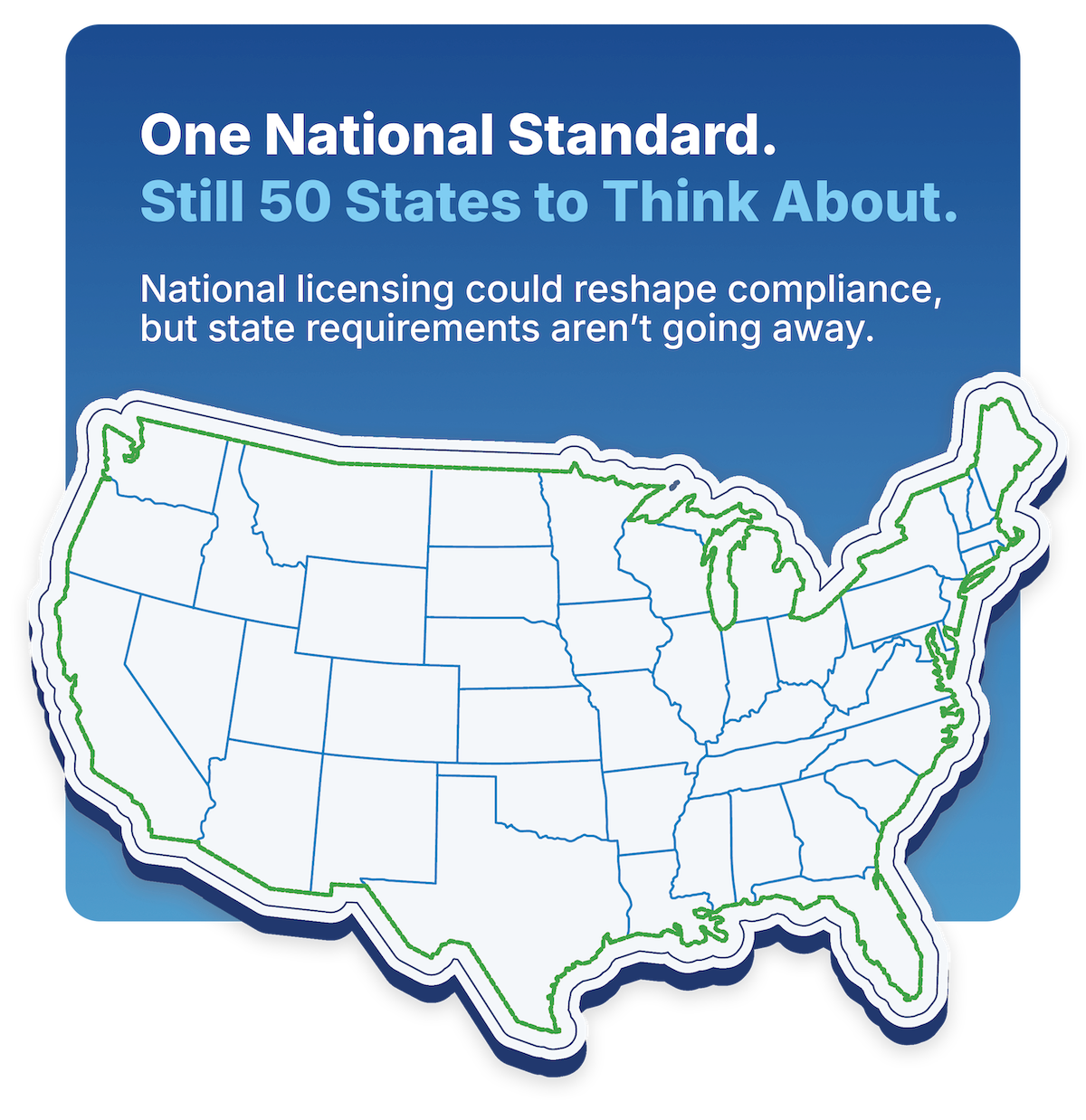
But “national standards” does not necessarily mean “one license and no more state compliance.” That distinction is critical.
National Standards Do Not Mean the End of State-Level Compliance
One of the biggest misconceptions surrounding national pharmaceutical licensing is that a federal framework will automatically eliminate the need to think about state requirements.
The transition may be much more complicated.
Industry discussions in 2026 have specifically focused on the question of how much state-level variation will remain after national licensure standards are implemented. Kala Shankle, Vice President of the Healthcare Distribution Alliance, noted in an interview with Pharmaceutical Commerce that the eventual impact will depend in part on how federal and state requirements interact and how states implement the new framework.
For companies operating in multiple jurisdictions, this means that the compliance challenge does not necessarily disappear when national standards arrive.
Instead, companies may need to manage a combination of federal standards, state implementation, existing licenses, new licensing processes, renewals, inspections, and potentially different transition timelines.
That could create a particularly important period for pharmaceutical license management. Companies will need to understand not only what the new national requirements say, but also what happens to the licenses they already hold.
What National Licensing Could Mean for Pharmaceutical Distributors
Wholesale drug distributors are likely to be among the companies most directly affected by the move toward national licensure standards.
Today, distributors must maintain appropriate state licenses and comply with applicable federal requirements. The FDA also requires wholesale drug distributors and 3PLs to report certain licensure information annually as part of the DSCSA framework. The FDA’s reporting database contains information submitted by distributors and 3PLs, although the FDA specifically notes that appearing in the database does not itself mean that a facility is licensed or compliant with applicable state and federal requirements.
A national licensing framework could create greater consistency in how distributors demonstrate compliance. For a distributor operating in dozens of states, that could eventually reduce some of the administrative burden associated with maintaining different licensing standards across jurisdictions.
But there will still be a critical need to understand where the company is authorized to operate and whether all applicable requirements have been satisfied.
During a transition, a distributor may have to answer questions such as whether an existing state license remains valid, whether a new application is required, whether an inspection must be completed, whether a state has adopted the national standard, and when the new requirements become applicable.
A company that assumes “national” means “automatic” could create a significant compliance gap.
3PLs May See Significant Changes As Well

Third-party logistics providers have an especially important role in this discussion because national licensure standards specifically address 3PLs.
The current regulatory framework recognizes 3PLs as distinct participants in the pharmaceutical supply chain and the FDA requires appropriate authorization for 3PLs involved in coordinating warehousing or other logistics services for manufacturers, wholesale distributors, or dispensers.
For companies operating multiple facilities, national standards could potentially create more consistency in areas such as facility requirements, personnel, recordkeeping, storage and handling, and inspection expectations.
However, 3PLs should not assume that a national standard eliminates the need for detailed license management.
Each facility may have its own license, operating location, activities, renewal dates, and compliance history. The FDA’s annual reporting system itself reflects this facility-level approach: one facility can have multiple licenses, and each license may appear as a separate record.
That means organizations will still need visibility into the individual licenses that make up their overall compliance portfolio.
What About Pharmaceutical Manufacturers?
Pharmaceutical manufacturers are not the primary focus of the FDA’s proposed national licensure framework for wholesale drug distributors and 3PLs. That distinction is important.
Manufacturers operate under a broader regulatory environment that includes federal requirements such as CGMP regulations, drug establishment registration, product requirements, and other FDA obligations, while state-specific licensing and permitting requirements may also apply depending on the company’s operations and jurisdictions.
For manufacturers, the development of national wholesale distributor and 3PL standards should be viewed as part of a larger regulatory trend rather than as the creation of a universal national pharmaceutical license.
Manufacturers frequently interact with distributors, 3PLs, pharmacies, and other supply-chain participants. Changes to licensing standards for those organizations can therefore have downstream effects on how manufacturers evaluate trading partners and manage their own compliance relationships.
In other words, even when a company is not directly subject to a new licensing framework, changes elsewhere in the pharmaceutical supply chain can still affect its compliance responsibilities and operational processes.
Compounding Pharmacies Face a Different Licensing Reality

The same distinction is important for compounding pharmacies.
503A compounding pharmacies and 503B outsourcing facilities operate under distinct regulatory frameworks and their licensing requirements can involve both federal and state considerations. A national licensing framework designed for wholesale drug distributors and 3PLs should not be interpreted as a national license for compounding pharmacies.
State pharmacy laws and board of pharmacy requirements remain highly relevant to compounding operations. Depending on the pharmacy’s business model, location, activities, and distribution footprint, a company may have to manage multiple state licenses and registrations.
For a compounding pharmacy expanding into additional states, the licensing analysis can become especially complicated.
A pharmacy may need to determine whether it requires a nonresident pharmacy license, whether additional permits or registrations apply, whether its compounding activities trigger other requirements, and what obligations continue after the license is obtained.
That is why state-specific pharmaceutical license management remains important even as the industry moves toward greater national standardization in certain areas.
The Real Challenge May Be the Transition
The pharmaceutical industry has a tendency to focus on the destination. In this case, however, the transition may be just as important.
Moving from a state-by-state licensing environment toward national standards will not happen instantaneously. Companies will need to understand the final federal requirements, monitor state implementation, evaluate their existing licenses, determine whether applications or amendments are necessary, and update internal compliance processes.
This is where organizations with large pharmaceutical license portfolios could face a significant administrative challenge.
Imagine a distributor with licenses in 40 states. If national licensing standards change the requirements governing those licenses, the company cannot simply update one record and move on. Its compliance team may need to determine how the new framework affects each jurisdiction, each facility, each license, and each renewal cycle.
The same principle applies to companies managing other types of pharmaceutical licenses. Regulatory change creates another layer of work for compliance teams that are already responsible for keeping licenses current.
Why License Management Will Still Matter in a National Framework
It may seem counterintuitive but national standardization could actually make pharmaceutical license management more important, not less.
When regulations change, companies need to know exactly what they currently hold before they can determine what needs to change. That means maintaining an accurate inventory of licenses, facilities, jurisdictions, expiration dates, license types, regulatory obligations, and supporting documentation remains essential.
A company cannot effectively transition its license portfolio if it does not have a clear understanding of that portfolio in the first place.
For pharmaceutical manufacturers, distributors, and compounding pharmacies, this is particularly important because licensing requirements can extend beyond a company’s primary facility.
Companies may have multiple operating locations, distribution centers, pharmacies, warehouses, manufacturing facilities, or other regulated locations. Each can introduce additional licensing and compliance considerations.
A centralized pharmaceutical license management strategy gives compliance teams the visibility they need to understand how regulatory changes affect the organization.
National Licensing May Reduce Complexity, But It Will Not Eliminate Compliance

There is a legitimate opportunity for national licensing standards to make parts of pharmaceutical compliance more consistent.
For wholesale drug distributors and 3PLs, a standardized framework could reduce some of the differences that companies currently encounter from state to state. It could create clearer expectations for licensing, improve consistency across jurisdictions, and potentially make it easier for companies to expand their operations.
But standardization should not be confused with simplicity. Pharmaceutical companies will still need to understand their regulatory obligations, maintain appropriate licenses, monitor changes, complete renewals, manage documentation, and demonstrate compliance.
And for manufacturers and compounding pharmacies, state-specific requirements will continue to be an important part of the compliance landscape even as national standards evolve in other areas.
The future of pharmaceutical licensing may therefore be less about choosing between national licensing and state licensing and more about learning how the two systems interact.
The Pharmaceutical Compliance Landscape Is Changing
The move toward national licensing standards is an important development for the pharmaceutical industry, particularly for wholesale distributors and 3PLs.
But companies should resist the temptation to treat nationalization as a regulatory shortcut. The reality is likely to be more nuanced.
As the FDA develops national standards and states respond to those changes, pharmaceutical organizations will need to monitor the regulatory landscape closely and understand how changes affect their individual operations.
For distributors and 3PLs, that means preparing for potential changes to existing licensing structures. For manufacturers, it means understanding how changes to distributor and logistics licensing may affect supply-chain relationships. For 503A and 503B compounding pharmacies, it means recognizing that national standards for distributors and 3PLs do not eliminate the need to manage state-specific pharmacy licensing requirements.
Across all three groups, one principle remains the same: Regulatory change does not eliminate the need for license management. It makes accurate license management more important.
Preparing for the Future of Pharmaceutical Licensing
The pharmaceutical regulatory environment is becoming increasingly interconnected. Federal requirements, state licensing laws, board of pharmacy regulations, supply-chain standards, and evolving national frameworks can all affect how a company operates.
For organizations managing licenses across multiple jurisdictions, keeping track of those requirements manually can become increasingly difficult.
State License Servicing helps pharmaceutical manufacturers, distributors, pharmacies, and other life sciences organizations manage their state license portfolios, monitor renewal requirements, and maintain visibility into their licensing obligations.
As pharmaceutical licensing evolves, having an accurate, centralized view of your license portfolio can help your organization understand where it stands today and prepare for what comes next.